The Express Entry Secret: This One Factor Gives More CRS Points Than Age

The Strategic Factor Most Applicants Overlook
We recently asked our community: "Which factor has the potential to give you more CRS points: Age or Language?"
The answers were understandable. Many assumed Age was the right answer. After all, you get the maximum 110 points (if single) by being in the 20-29 age bracket, according to IRCC's Comprehensive Ranking System. Others guessed Education or Work Experience.
The correct answer? Language.
This isn't a trick question. It's the single most overlooked strategic opportunity in the entire Comprehensive Ranking System (CRS)—and as a Regulated Canadian Immigration Consultant (RCIC) with 8+ years of experience helping thousands of applicants optimize their Express Entry profiles, I've seen this oversight cost candidates their Invitation to Apply (ITA) repeatedly.
Most applicants treat the language test as a simple pass/fail. They aim for a "good" score—like a CLB 7 or 8—and once they have it, they stop. This is one of the biggest strategic mistakes you can make in your Express Entry profile.
You can't change your age. You can't easily get a new degree. But you can change your language score.
Here is the strategic breakdown of how CLB 9+ creates a compounding point effect that most applicants (and even many consultants) miss—and why this single factor can add 50-80+ points to your CRS score.
The Age "Cliff": A Factor You Can't Control
Let's first look at age. The points for age are fixed, as outlined in IRCC's official CRS grid. If you are between 20 and 29, you get the maximum 110 points (as a single applicant). The moment you turn 30, you drop to 105 points. At 31, you get 99 points. At 35, you're down to 77 points. By 40, you're at 50 points.
It is a factor of "diminishing returns" that you have zero control over. You can't study to get younger. It's a static number that, for most professionals in their 30s, only goes down.
For many skilled workers applying through Express Entry, age is simply not a lever they can pull. You're 32? You're 35? That's your reality. The points are what they are.
The Language "Rocket": How CLB 9+ Creates a Compounding Effect
Language, on the other hand, is the factor you have the most control over. And crucially, it doesn't just add points—it multiplies them.
The magic happens in a part of the CRS grid that most people ignore: the Skill-Transferability Factors.
This is where the system combines your language ability with your education and work experience to unlock a massive trove of "bonus" points that many applicants never realize exist.
Let's look at the math.
The "Compounding" Power of Education + Language
This is the most powerful combination. The system heavily rewards high language scores paired with education, as detailed in IRCC's Skill-Transferability Factors section.
Scenario 1: "Good" Language (CLB 7-8, but not all skills at CLB 9)
You have a Master's degree
You have CLB 7 or higher, but one or more skills below CLB 9
In the Skill-Transferability section, this combination is worth 25 points
Scenario 2: "Excellent" Language (CLB 9+ in ALL four abilities)
You have the same Master's degree
You achieve CLB 9 or higher in ALL four abilities (Reading, Writing, Speaking, Listening)
That same combination now gives you 50 points
By improving your language score from "good" to "excellent," you just doubled your points in this category, adding 25 points to your total CRS score.
⚠️ CRITICAL REQUIREMENT: ALL Four Abilities at CLB 9+
This is where most applicants trip up. To unlock the maximum 50-point Skill Transferability bonus, you need CLB 9 or higher in ALL FOUR language abilities:
✅ Reading: CLB 9+
✅ Writing: CLB 9+
✅ Speaking: CLB 9+
✅ Listening: CLB 9+
Having CLB 10 in three skills and CLB 8 in one does NOT qualify. All four must be CLB 9 or higher to unlock the full transferability bonus.
This requirement is explicitly stated in IRCC's official CRS criteria: "CLB 9 or more on all four first official language abilities."
The "Compounding" Power of Work Experience + Language
The exact same logic applies to your foreign work experience.
Scenario 1: "Good" Language (CLB 7+, but not all at CLB 9)
You have 3+ years of foreign work experience
You have CLB 7 or higher, but one or more skills below CLB 9
This combination is worth 25 points
Scenario 2: "Excellent" Language (CLB 9+ in ALL four abilities)
You have the same 3+ years of foreign work
You achieve CLB 9+ in all four abilities
This combination gives you 50 points
That's another 25-point jump from the same factor.
Putting It All Together: The 50-80+ Point Leap
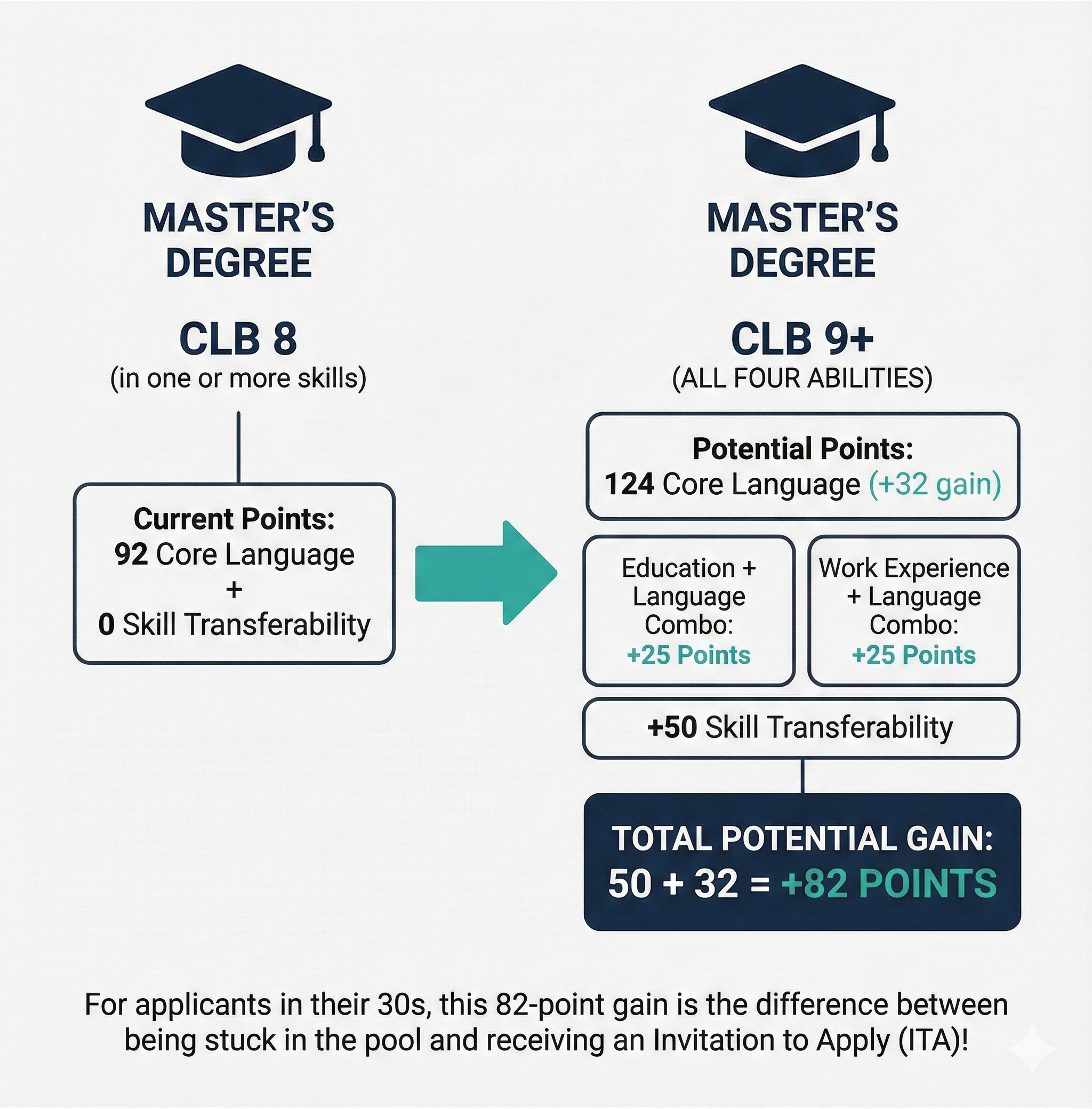
Let's imagine you are an applicant with a Master's degree and 3+ years of foreign work. You're sitting at CLB 8 in one or more skills (with others higher).
By focusing, studying, and re-taking that test to achieve CLB 9+ in all four abilities, you don't just gain a few extra language points. You unlock:
Skill Transferability Gains:
+25 points from your Education + Language combo
+25 points from your Work Experience + Language combo
Subtotal: +50 points in Skill Transferability alone
Core Language Gains (for single applicants): According to IRCC's official point breakdown:
CLB 8 per ability = 23 points × 4 = 92 points total
CLB 9 per ability = 31 points × 4 = 124 points total
+32 points in core language points
TOTAL POTENTIAL GAIN: 50 + 32 = 82 points
For applicants with a spouse, the core language gain is slightly less (+28 points instead of +32), but the Skill Transferability gains remain the same (+50 points).
An applicant in their 30s (losing 5-10 points annually for age) can gain 82 points by mastering their language test. This is the difference between being stuck in the pool and receiving an Invitation to Apply (ITA).
Real Example from Our Practice
Please note: This is an illustrative example based on our consulting experience. Individual results will vary based on unique circumstances.
A client came to us with a CRS score of 445. She was 33 years old, had a Master's degree, and 4 years of foreign work experience. Her IELTS scores were CLB 8 across most bands, with one skill at CLB 9. She had been in the Express Entry pool for 8 months without an ITA.
We identified that by improving to CLB 9+ in all four abilities, she would unlock the Skill-Transferability bonuses. After 3 months of targeted language preparation and retaking IELTS, she achieved CLB 9 in all four skills. Her CRS score jumped to 502 points. She received an ITA in the very next Express Entry draw.
Important Update: Job Offers No Longer Give CRS Points (March 2025)
As of March 25, 2025, IRCC removed job offer points from the Comprehensive Ranking System. Previously, a job offer could add 50-200 points.
What this means: Language proficiency is now even more critical. With job offers no longer providing a CRS shortcut, language becomes one of the few remaining high-impact factors you can actively control.
Your Strategy: Stop "Passing" and Start "Mastering"
Your language test is not a hurdle to clear; it is the single most powerful tool for strategic leverage in your entire profile.
You cannot change your past. Your age is fixed. Your work history is done. Your degrees are on the wall. The only high-impact variable you can actively control is your language score.
For high-achieving professionals, this is a strategic mindset shift. The goal isn't to "pass" IELTS or CELPIP. The goal is to achieve CLB 9+ in all four abilities to unlock the compounding bonus points.
This is how we approach every Express Entry file at Benotas Immigration. We don't just "check" your language score. We model your CRS potential. We show you exactly how many points you are leaving on the table and build a strategy to get them.
Understanding Current CRS Cutoff Scores
According to IRCC's latest Express Entry rounds of invitations, the minimum CRS scores vary significantly by draw type:
General (all-program) draws: Typically 480-540 points
Category-based draws: Can be as low as 420-490 points depending on category
PNP-specific draws: Often 750+ points (due to 600-point provincial nomination)
Every point matters. Those 50-80 bonus points from improving language to CLB 9+ and unlocking Skill-Transferability Factors can be the difference between waiting months for an ITA and receiving one in the next draw.
Common Mistakes to Avoid
1. Settling for CLB 7 or 8
Many applicants think "good enough" is enough. It's not. CLB 9+ in all four abilities unlocks the bonus points.
2. Not retaking the test
If you're close to CLB 9 in one or more skills, retake the test. The investment is worth it for 50-80 additional CRS points.
3. Focusing only on one skill
You need CLB 9 in ALL four skills (Listening, Reading, Writing, Speaking) to unlock the full Skill-Transferability bonus. Having three skills at CLB 9 and one at CLB 8 won't work.
4. Ignoring the Skill-Transferability section
Many applicants don't even know this section exists. It's where the real point gains happen.
5. Not modeling different scenarios
Use the official CRS calculator to see exactly how many points you'd gain with CLB 9+ before you commit to retaking the test.
Timeline & Next Steps
If you're currently below CLB 9 in one or more skills and want to reach CLB 9+:
1. Assess your current scores
Identify which skills need improvement (usually Writing and Speaking are the bottlenecks).
2. Create a study plan
Allocate 2-3 months for focused preparation. This isn't about general English—it's about test strategy.
3. Take practice tests
Use official IELTS or CELPIP practice materials to gauge your readiness.
4. Retake the test
Once you're consistently scoring CLB 9+ in all four skills in practice tests, book your official test.
5. Update your Express Entry profile
As soon as you receive your new scores, update your profile immediately. Your CRS score will recalculate automatically.
The investment:
A few months of focused study
Cost of retaking the test (approximately $300-400 CAD)
The return:
50-80 additional CRS points
Potentially the difference between waiting indefinitely and receiving an ITA
Frequently Asked Questions (FAQ)
Q: How many CRS points do I get for CLB 9 vs CLB 8?
A: The difference isn't just in direct language points. CLB 9 in all four abilities unlocks Skill-Transferability bonus points that can add 50 points in transferability plus up to 32 additional core language points (for single applicants) to your total CRS score, depending on your education and work experience combination.
Q: Do I need CLB 9 in all four skills to get the bonus points?
A: Yes. To unlock the full Skill-Transferability bonus, you need CLB 9 or higher in ALL FOUR language skills (Listening, Reading, Writing, Speaking). This is explicitly stated in IRCC's official criteria.
Q: Is it worth retaking IELTS/CELPIP just to go from CLB 8 to CLB 9?
A: Absolutely. The 50-80 point gain from Skill-Transferability Factors plus core language improvements can be the difference between receiving an ITA and waiting months or years in the pool. For most applicants, it's the highest-ROI action they can take.
Q: How long does it take to improve from CLB 8 to CLB 9?
A: Most applicants need 2-3 months of focused preparation, depending on which skills need improvement. Writing and Speaking typically require more practice than Reading and Listening.
Q: Can I get Skill-Transferability points with a Bachelor's degree and CLB 9?
A: Yes. According to IRCC's criteria, a Bachelor's degree (or three or more year program) + CLB 9 in all four abilities typically gives you 50 points in the Education + Language Skill-Transferability section—the same as a Master's degree.
Q: What if I'm already 35+ and losing age points? Is language still worth it?
A: Yes, even more so. Since you can't control your age, language becomes your most powerful lever. An 82-point gain from CLB 9+ can offset multiple years of age-related point losses and more.
Q: Do these Skill-Transferability points apply to both English and French?
A: Yes. You can get Skill-Transferability bonus points for either English (CLB 9+) or French (NCLC 7+). In fact, having strong scores in both languages can unlock even more bonus points through the Additional Points section.
Q: How do I know my CLB level from my test scores?
A: IRCC provides official language test equivalency charts showing how IELTS, CELPIP, TEF, and TCF scores convert to CLB/NCLC levels.
Conclusion
Don't let a "good enough" language score keep you from an invitation.
Your Express Entry profile is a competition, not a waiting list. Every point matters. And while you can't change your age, you can absolutely change your language score.
The Skill-Transferability Factors are where strategic Express Entry applicants separate themselves from the pack. Those 50-80 bonus points aren't just numbers—they're your ticket to Canada.
This is how we approach every Express Entry file at Benotas Immigration. We don't just help you submit an application. We help you optimize every single point you're entitled to. Our Express Entry Profile Optimization services are designed to find every single point you're leaving on the table.
Book a consultation today, and let's model your true CRS potential. We'll show you exactly how many points CLB 9+ could add to your score—and build a strategy to get you there.
Additional Resources
Disclaimer: This article provides general information about Canadian Express Entry requirements and CRS point optimization strategies. It is not legal advice. Individual results may vary based on unique circumstances. For personalized guidance on your specific situation, consult with a Regulated Canadian Immigration Consultant (RCIC) or immigration lawyer. Client examples are illustrative and based on our consulting experience; your results may differ.
Last updated: December 2025 | All information reflects current IRCC requirements as of the date of publication