You Got Your ITA! Congratulations. Now, Don't Get Refused

The Critical 60-Day Window That Determines Your Canadian PR Future
That feeling is incredible, isn't it? After months—maybe years—of tracking your CRS score, retaking language tests, and waiting for that magic email, it finally happened. You received your Invitation to Apply (ITA) for permanent residence.
You should celebrate. Take a moment. We've celebrated with hundreds of clients at this exact stage. It's a massive achievement.
CRITICAL UPDATE (August 21, 2025): IRCC now requires an upfront medical exam before you submit your PR application. This is a major recent change - read more in section 3 below.
Now, here's the reality check: an ITA is not a guarantee of permanent residence. It is permission to start the most critical stage of your immigration journey—where even small oversights can result in refusal.
It's time to get strategic.
The Mindset Shift: From CRS Points to Legal Evidence
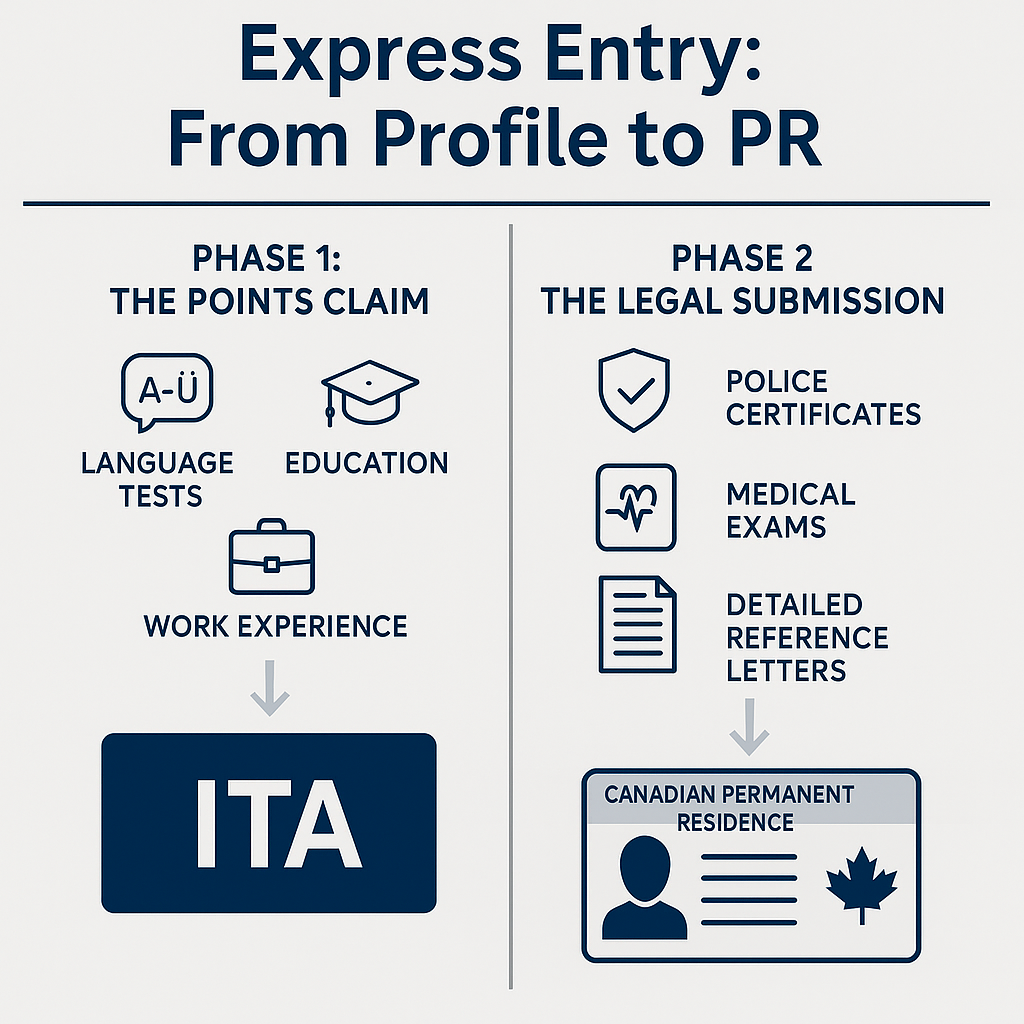
Up to this point, you've been playing a points game. Your Express Entry profile was a series of claims: "I have a Master's degree. I have three years of skilled work experience. My English is a CLB 9."
The system took you at your word and, based on those claims, gave you an ITA.
Now, you have 60 days to prove every single claim with flawless, irrefutable documentation.
Your Express Entry application is not a form—it's a legal submission. You are no longer an applicant; you are building a case. And the person reviewing it is not a customer service representative. They are a highly trained IRCC officer whose job is to verify that your submission meets all legal and documentary requirements.
You are a high-achieving professional. You are detail-oriented, successful, and proactive. This is exactly why you're at risk. The "DIY" impulse is strong, but this is a legal process where the responsibility to fully prove every claim rests entirely on you.
In our experience as RCIC immigration consultants, we see smart, qualified people get refused every day—not because they weren't eligible, but because their documentation did not adequately support their claims.
Common Express Entry Refusals: Where High-Achievers Stumble
You don't know what you don't know. IRCC officers review your file with the experience of thousands of applications, trained to spot documentation gaps that "checklist-only" applicants commonly overlook.
1. The Fatal NOC Mismatch
This is the number one cause of otherwise perfect applications being refused.
The Mistake: You claimed points for "Senior Marketing Manager" and your reference letter confirms you held the title "Marketing Manager." Seems straightforward, right? Wrong.
The Reality: IRCC officers don't assess your job title—they assess your job duties. They will compare the duties listed in your reference letter against the lead statement and main duties for your National Occupational Classification (NOC) code.
Since November 16, 2022, Canada uses the NOC 2021 TEER system—a five-digit code structure based on Training, Education, Experience, and Responsibilities. Unlike the previous NOC 2016 system with skill levels (0, A, B, C, D), NOC 2021 uses TEER categories 0-5.
The Refusal Risk: If your letter's duties don't align precisely with your claimed NOC code, or if the descriptions are vague ("responsible for marketing activities"), the officer may conclude you did not perform the duties of the NOC you claimed.
The Consequence: If your work experience points aren't recognized because of a NOC mismatch, your CRS score could drop below the cut-off of your draw—resulting in refusal.
2. Inconsistent Personal & Travel History
You must list every address where you've lived and every international trip you've taken in the last 10 years. It's tempting to generalize or estimate.
The Mistake: You forget that three-week backpacking trip to Southeast Asia five years ago. Or you can't remember exact dates for an address in 2017, so you guess.
The Reality: The officer sees the entry/exit stamp from Thailand in your passport scan. It doesn't match your declared travel history. You listed your Toronto address from "2017-2019," but your driver's license shows a different address in 2018.
The Risk: A small inconsistency creates doubt. A pattern of inconsistencies or a significant omission can be interpreted as misrepresentation under section 40(1)(a) of the Immigration and Refugee Protection Act (IRPA).
Critical Distinction: A refusal for an incomplete application is not the same as a refusal for misrepresentation. However, if IRCC determines you deliberately withheld material facts or provided false information that could induce an error in processing, you could face a five-year ban from applying for any Canadian immigration benefit.
3. Insufficient Proof of Funds Documentation
Important Note: Proof of funds is required only for Federal Skilled Worker Program (FSWP) and Federal Skilled Trades Program (FSTP) applicants. If you're applying through the Canadian Experience Class (CEC) or have a valid job offer with authorized work status, you are exempt from this requirement.
For those who need it:
The Mistake: You submit a bank letter showing your current balance. Done, right? Not quite.
The Reality: IRCC doesn't just want to see a balance. They need to verify the source and accessibility of your funds. Where did that $20,000 come from? Was it deposited last week just to meet the requirement?
The Requirement: According to IRCC's official guidance, you must provide:
Official letters from financial institutions on letterhead
Account details including account numbers, opening dates, current balances, and average balances for the past 6 months
Documentation for any large deposits (gift deeds, sale receipts, bonus letters)
Proof that funds are unencumbered and accessible
The 2025 minimum settlement funds (updated July 7, 2025, effective July 28, 2025) are:
The Refusal: If you cannot demonstrate that funds are legitimate, accessible, and maintained over time, your application can be refused for failing to meet financial requirements.
Building Your Case: A Strategic Post-ITA Action Plan
A simple checklist isn't enough. You need a strategic, methodical approach. Here's how we build refusal-proof applications at Benotas Immigration.
1. The "Burden of Proof" Audit
Print your submitted Express Entry profile. Review it line by line. For every point you claimed, ask yourself: "What single document can I produce that proves this claim beyond any doubt?"
This becomes your evidence roadmap.
2. Obtain Police Certificates Immediately
This is the document that depends on foreign governments—and processing times vary wildly by country.
The Requirement: You need a police certificate from every country where you have lived for 6 months or more in a row (consecutively, not cumulatively) since you turned 18.
Important clarifications:
The certificate must be issued after the last time you stayed there for 6+ months
For your current country of residence, the certificate must be issued no more than 6 months before you submit your application
You do not need certificates for time spent in Canada
Certificates must be colour scans of originals (not photocopies)
Pro tip: Some countries require an official request letter from IRCC before they will issue a certificate. If this applies to you, submit a placeholder document stating: "I am applying from a country that requires an official request letter from IRCC to get a police certificate." IRCC will then provide the request letter.
Start this process NOW. Some certificates take 8-12 weeks to obtain.
3. Complete Your Upfront Medical Examination (CRITICAL CHANGE as of August 21, 2025)
IMPORTANT: As of August 21, 2025, IRCC now requires an upfront Immigration Medical Exam (IME) BEFORE you submit your permanent residence application. This is a major policy change.
What this means:
You must complete your medical exam and receive your IME results before the 60-day ITA deadline
Your application will be considered incomplete and may be refused if you don't include proof of your completed medical exam
The exam must be performed by an IRCC-approved panel physician
All family members (including spouse and dependent children) must complete the exam, even if they're not coming to Canada with you
Timing is critical: Medical exams are valid for 12 months from the exam date. You should complete your exam soon after receiving your ITA to ensure:
Results are ready before your 60-day submission deadline
The exam remains valid throughout IRCC processing (typically 6 months)
Exemptions exist for applicants who:
Already live in Canada
Completed an IME in the past 5 years
Were assessed as "low risk" or "no risk" to public health/safety
(This exemption is valid until October 5, 2029)
Cost: Expect to pay CAD $195-$390 per person, paid directly to the panel physician.
Action: Book your appointment immediately after receiving your ITA—panel physicians often have limited availability, and processing your results can take 10+ days.
4. Curate "Hyper-Detailed" Employment Reference Letters
This is your most critical documentation task.
Standard HR letters often lack the specificity IRCC requires. You need to ensure—or more realistically, provide your employer with a detailed template they can verify and sign—a letter that includes:
Required Elements:
Your exact job title
Specific start and end dates (DD/MM/YYYY format)
Your salary and benefits
Number of hours worked per week (must be 30+ for "full-time")
Most critically: A bullet-point list of your primary duties and responsibilities
The NOC Alignment Strategy:
Your duties must align with the lead statement and main duties of your NOC code. This is non-negotiable.
Best practice: Review your NOC code's official description. Draft duty statements that accurately reflect your actual work while using language that clearly corresponds to the NOC requirements. Provide this to your employer to verify, modify if needed, and sign.
For Canadian work experience: We also submit T4s, pay stubs, and Records of Employment (ROEs) to create multiple layers of corroborating evidence.
For international work experience: Submit pay slips, employment contracts, or any official documentation that verifies your employment.
5. Comprehensive Proof of Funds Documentation (If Required)
If you're an FSWP or FSTP applicant without a valid job offer:
Gather:
Six months of complete bank statements (not just balance summaries—full transaction histories)
Official letters from your financial institution on letterhead
Documentation for large deposits:
Gift from family? Get a notarized gift deed and proof the donor had those funds
Sold a vehicle? Include the bill of sale
Work bonus? Include the bonus letter from your employer
The goal: Create a clear financial narrative that shows funds are legitimate and have been in your possession over time.
6. The Letter of Explanation (LOE): Your Secret Weapon
Most applicants underestimate this document. A well-crafted Letter of Explanation is your one opportunity to speak directly to the officer reviewing your file.
Use it to proactively address anything unusual:
Examples of what to explain:
Employment gaps ("I was traveling between jobs—see travel history for dates")
A reference letter on plain paper ("Company ABC ceased operations in 2019; I've included articles confirming bankruptcy")
Large bank deposits ("This $15,000 deposit was from the sale of my vehicle—attached is the bill of sale")
Name variations across documents ("My passport shows my full legal name; my university degree uses my preferred name")
Missing documents ("Police certificate from Country X is delayed; I've included proof of application—tracking number ABC123")
The purpose: A transparent, well-organized LOE builds credibility. It shows you are honest, detail-oriented, and have done the work for the officer. It transforms potential red flags into explained facts.
The Stakes: Why "Good Enough" Isn't Good Enough
You are at the goal line. You can see permanent residence within reach. This stage is too critical for shortcuts.
What happens if you're refused?
For incomplete applications: You will have to start over and resubmit your Express Entry Profile.
For insufficient evidence: Your application is refused, and you must start over (if you're still eligible)
For misrepresentation: A finding under section 40(1)(a) of IRPA results in a five-year ban from applying for any Canadian visa, study permit, work permit, or permanent residence
Your entire future in Canada—your career, your home, your life—depends on this single application being complete, accurate, and professionally documented.
This is not the time for "good enough." It's the time for a refusal-proof strategy.
How Benotas Immigration Helps You Succeed
At Benotas Immigration, we are strategic partners, not just form-fillers.
Our approach:
We review your file with the same scrutiny an IRCC officer will apply
We audit your claims against documentary evidence to identify gaps
We help you curate evidence that is clear, consistent, and comprehensive
We draft strategic Letters of Explanation that address ambiguities proactively
We ensure your NOC duties, employment letters, and supporting documents align perfectly
We've built our reputation on helping high-achieving professionals like you navigate this exact, high-stakes moment.
The celebration for your ITA was real. Let us help you make your permanent residence a reality.
Next Steps: Protect Your Canadian Dream
Don't let your Canadian dream be derailed by a preventable documentation gap.
We offer two service levels:
DIY Application Review
For professionals who have prepared their own documentation but want an RCIC's final approval and strategic guidance before submission.
Full Representation
For those who want to place their case in expert hands from ITA receipt through to COPR.
Frequently Asked Questions
Q: I have an ITA—am I guaranteed permanent residence?
A: No. An ITA gives you permission to apply, but your application must meet all documentary requirements and prove every claim you made in your Express Entry profile.
Q: What's the difference between a regular refusal and a misrepresentation finding?
A: A regular refusal (for insufficient documentation or not meeting requirements) allows you to potentially reapply. A misrepresentation finding under section 40 results in a five-year ban from Canada.
Q: Do I need proof of funds if I'm a CEC applicant?
A: No. Proof of funds is not required for Canadian Experience Class applicants.
Q: What changed with medical exams in August 2025?
A: As of August 21, 2025, Express Entry applicants must complete an upfront medical exam BEFORE submitting their PR application. Previously, you could wait for IRCC to request it after submission. Applications without proof of a completed medical exam will be considered incomplete.
Q: How do I find my NOC code under the new system?
A: Use the official NOC 2021 search tool. Since November 2022, Canada uses five-digit codes based on TEER categories.
Q: What if I can't get my police certificate in time?
A: You can submit proof that you've applied (receipt, tracking number) along with a Letter of Explanation. However, final acceptance is at the officer's discretion.
Additional Resources
Ready to secure your Canadian future?
Book a consultation with Benotas Immigration today
This article provides general information about Canadian Express Entry requirements. It is not legal advice. For personalized guidance on your specific situation, consult with a Regulated Canadian Immigration Consultant (RCIC) or immigration lawyer.
Last updated: November 2025 | All information reflects current IRCC requirements and regulations